Підручник Англійська мова 7 клас (7-й рік навчання) - Карпюк О. Д. - Астон 2015 рік
Unit 2 AT HOME
Lesson 2 ALL ABOUT FOOD
READING
1. a) Work in groups. Discuss the questions below.
✵ What food should we eat to stay healthy?
✵ What food shouldn’t we eat too much?
b) Read the text to find out if it mentions your ideas.
To stay healthy you should eat as much fresh food as possible. You shouldn’t eat too much food from packages. There’s too much sugar and salt in it.
Eat vegetables, fruits, nuts, fish, yoghurt and olive oil. You shouldn’t eat too much meat. Eat tomatoes, peppers, broccoli, spinach, and beans instead. Brown bread is better than white bread. If you want something sweet, eat fruit: an apple, a peach or some plums or cherries. If you are thirsty, you should drink water and not a fizzy drink.
The best food is local food. When it comes to your table it is fresh, full of vitamins and minerals. Today many people want to eat organic food. It is the food produced without chemicals, in a traditional way.
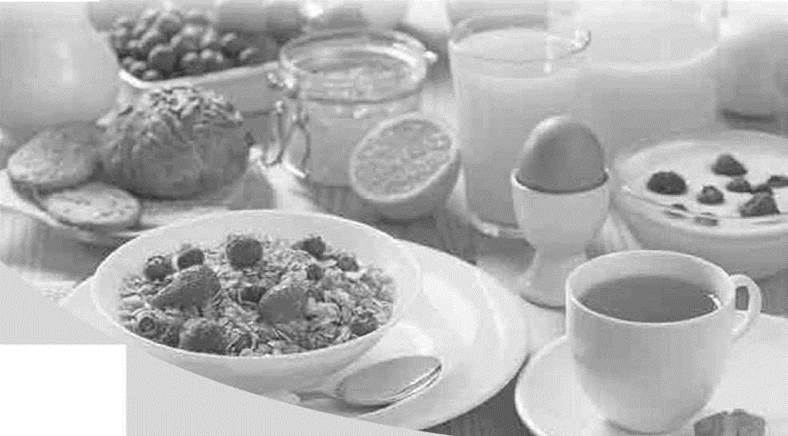
While watching a cooking programme on TV why not use your kitchen and prepare some fresh food for yourself and your friends. You can also try to grow some food yourself. Plant a tomato or some peas, perhaps.
2. Work in pairs. Answer the questions.
1 Why is fresh food better than food from packages?
2 What kind of oil is the best for your health?
3 Is white bread better for you than brown bread?
4 Why do some people want to eat organic food?
3. Read the sentences 1-6 and match them with the correct places in the text.
1 Eat them before doing sports.
2 Eat these foods before sitting down to do your schoolwork because they are full of protein and healthy fats.
3 It’s never too early to start thinking about what you eat!
4 It is the mineral which helps our body stay healthy and fight illness.
5 You need about ten glasses every day.
6 If you have them as snacks, you will have a nicer smile and you can even kiss somebody.
POWER FOODS
People, like all living organisms, need food to live. Food gives us energy for every action we do, from writing homework to running. It helps us build and repair things in our body and it helps our organs function well. A good choice of food can make us healthier and, believe it or not, more beautiful and successful as well. You may be surprised by the following list but the food on it is really great for you …

FOR MORE ENERGY
Pasta, potatoes and breakfast cereal all have a lot of carbohydrates and are real energy- givers. … If you have them before an important football match or a swimming competition, make sure to have a full plate.
FOR STRONGER IMMUNITY
Did you know that eggs have many different vitamins and also a lot of zinc… If you eat them, you will be healthier.
FOR BETTER CONCENTRATION
… Chicken, fish and nuts increase the production of dopamine 1 in your brain 2 which helps you concentrate. If you eat grilled (not fried) chicken, fish and nuts you will remember more of what you are studying.

FOR WHITER TEETH
Apples and raw 3 carrots are similar to small toothbrushes which polish your teeth and after eating them your mouth will smell sweet. …

FOR CLEARER SKIN
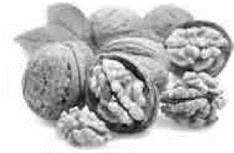
Walnuts 4 are rich in omega-3 fatty acids and after eating them you will have fewer pimples. Water is necessary for fresh and healthy looking skin. … If you drink a lot of it, your skin will be as beautiful as a baby’s.
ʊɑ
1dopamine [d
 pәmaın] — дофамин (гормон)
2brain [breın] — мозок
3raw [rɔ:] — сирий
4a walnut ['wɔ:lnᴧt] — волоський горіх
4. Read aloud the text from task 3 and check your answers with the whole class.
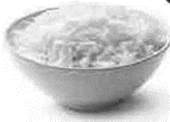
boiled rice

fried eggs

grilled fish

roast [rәʊst] chicken

5. Read the text in task 3 again and match the words in blue with their definitions below.
a (adj.) physically strong and not often ill…
b (adj.) cook in hot fat or oil…
c (n.) food made from grain, such as cornflakes or muesli
d (v.) fix something that is not working well, so it is in perfect condition again
e (v.) to make larger in number or amount…
f (n.) a small infected spot on the skin of the face…
g (adj.) cook without fat, on an open fire or in an oven
h (n.) something small, like a sandwich, chocolate or an apple, that you eat between meals………………….
6. Make a list of rules for healthy eating habits.
DO YOU KNOW?
The four most important food plants in the world are wheat, corn, rice and potatoes. We eat a lot of wheat. It’s in our bread, pasta and cakes. People in Africa eat a lot of corn.
Rice is the main food in Asia where they eat it for breakfast, dinner and supper.
Potatoes are from South America. They came to Europe with the Spanish and became food for the poor because you can grow a lot of potatoes on a small piece of land and they fill your stomach. A tragedy happened in Ireland in the nineteenth century. There was a potato disease and one million people died of hunger. Do you know that more than 800 million people in the world don’t have enough food? 16 000 children die of hunger every day. This number is unfortunately growing. This is sad because many people have so much food that they have problems with weight. What do you think?

LEARNING TIP
Using Dictionaries
Dictionaries present words in alphabetical order. A dictionary entry can show:
✵ how a word is pronounced
✵ what part of speech it is
✵ a simple explanation 1
✵ an example sentence.
Use dictionaries while you learn English.
1an explanation [,eksplә'neıʃen] — пояснення
VOCABULARY
1. Match the words with the pictures from (a) to (j).

2. Read and fill in the words from the box.
put (3 times), cut, eat, slice (twice)
3. Put the sentences in the correct order to get a recipe for pancakes.

PANCAKES
□ After that put in a spoon of sugar.
□ Serve the pancakes with jam or chocolate.
□ First mix the eggs and the milk.
□ For the pancakes you need 2 cups of flour, 1 egg, 1 cup of milk and a spoon of sugar.
□ Finally fry the pancakes.
□ Then add the flour.

4. Look at the picture and complete the text on page 71.

1 glass of grape juice
2 salt and (black) pepper
3 bottle of mineral water
4 oil
5 vinegar
6 glass of orange juice
7 napkin
8 bowl
9 plate
10 fork
11 knife
12 spoon
On the table, each person has a knife, (1) f_ _k, and (2) s_ _ _n, and a (3) n_ _ _ _n for their hands and face. They each have a white (4) p_ _ _e and a (5) b_ _I. To drink, there’s a (6) b_ _ _ _ e of (7) m_ _ _ _I w_ _ _r, and two (8) g_ _ _ _s of (9) j_ _ _e: one (10) g_ _e and the other (11) o_ _ _ _e. There is also some (12) s _ t and (13) b_ _ _k p_ _ _ _ r, and little (14) b_ _ _ _ _s of (15) o_I and
(16) v_ _ _ _r.
5. Complete the sentences.
1 Three meals of the day: breakfast, lunch and dinner
2 Three things you eat with: knife,… ,
and …
3 Three parts in a meal: starter,… ,
and …
4 Two things you find on a restaurant table:
salt and …
5 Two things you put on salad: oil and …
6 Two types of mineral water: still and …

LISTENING
1. Work in pairs. Speak on the questions.
1 What do people do in the kitchen?
2 Who does the cooking in your house?
3 What is salad usually made of?
4 What cooking methods do you know?
5 Do you know the difference between baking and boiling?
2. Listen to the part of the TV show and complete the sentences.
1 There are different knives on the table: …
2 Englishmen usually use different forks: …
3 In the oven Englishmen bake …
4 Boiling means … and frying means …
5 A cup of coffee means …
6 A coffee cup may be …
7 The difference between ’a pot of tea’ and ’a tea pot’ is in that a …
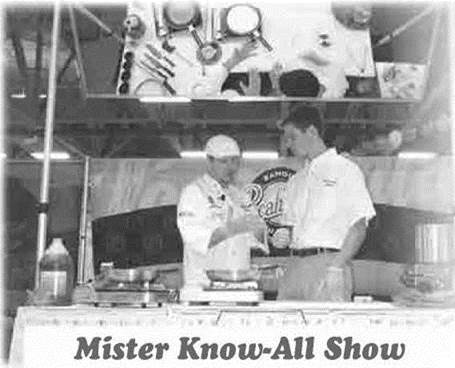
3. Work in groups. Read and discuss the topic.

When the dishes are ready we are busy with laying the table. For festive dinner it is important to decorate the dishes beautifully and to set the table correctly.
My granny taught me about the ’place settings’ and I am ready to share my knowledge about it with you.
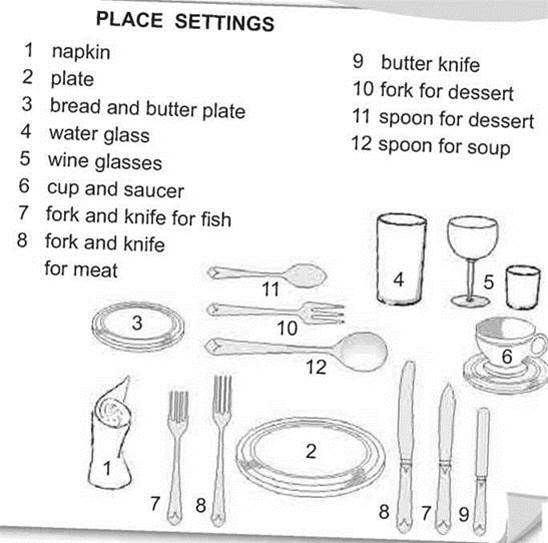
4. Work in pairs. Speak on table manners.
Use ’must’ or ’mustn’t’ to fill in the sentences.
TABLE MANNERS
1 You … eat and speak at the same time.
2 You … wash your hands before eating.
3 You … lick your knife and put it in your mouth.
4 You … eat with your fingers.
5 You … eat loudly.
6 You … use a napkin to clean your mouth.
7 You … leave the table while the others are still eating.
8 You … let an older person take food first.
9 You … sing or whistle while are eating.
10 You … try not to make a mess around your plate.
GRAMMAR
REMEMBER!
A lot of / Lots of вживається зі злічуваними та незлічуваними іменниками для того, щоб вказати на велику чисельність або кількість чогось.
Jill has got a lot of / lots of clothes.
This game is a lot of / lots of fun.
A little означає малу кількість і вживається із незлічуваними іменниками.
I need a little sugar for the cake.
Give the cat a little milk.
A few означає малу чисельність і вживається зі злічувальними іменниками.
There are a few nice apples.
Let me give you a few instructions.
1. Use ’a little’ or ’a few’ with the following nouns.
food |
sugar |
money |
air |
schools |
coins |
days |
cars |
ice cream |
advice |
tomatoes |
luggage |
2. Complete the questions using ’a little’ or ’a few’.
1 I’ve got a nice cake. Would you like …?
2 Would you like … sandwiches?
3 Do you want … sugar in your tea?
4 Do you need … more information about this cell phone?
5 Let me give you … advice.
6 Would you like … slices of cheese?
7 Open the window! We need … fresh air here!
8 You will get … nice presents for your birthday, won’t you?
9 Would you like … coffee to help you stay awake?
10 Shall I give you … money to buy some souvenirs?
3. Complete the dialogue with ’a lot of / lots of’, ’a little’ or ’a few’.
A: Have you got … time to help me fix my bike?
B: Sorry, I haven’t. I am very busy. I’ve got … things to do.
A: Yes, but it won’t take long! An hour, that’s all! I have to fix … things and I need … help.
B: Sorry, I can’t. But Bill has got … time! He isn’t doing anything!
4. Complete with ’ a lot more / lots more’, ’ a little more’ or ’a few more’.
1. A: How many apples do you want?
B: I’ve got one. I want … more.
2. A: How much snow are you expecting?
B: This is nothing. We are expecting … . Our winters are usually very snowy!
3. A: Are you still thirsty?
B: Yes, I am. I’d like … water, please. A small glass will be enough.
4. A: How do you like your cheeseburger?
B: It’s OK. But … cheese in it would be great!
5. A: The history teacher didn’t give us very much homework last time.
B: Don’t worry. She’ll give us … on Friday. She usually does.
6. A: What are you doing?
B: I am making … sandwiches. We have ten already, but we will need fifteen.

SPEAKING
1. Listen and act out the dialogue.
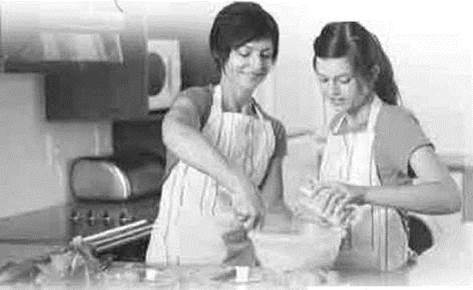
Mother: What’s the time dear?
Ann: It’s half past six. Why?
Mother: Father comes at 7.00. Can you help me to lay the table?
Ann: Sure, mum. What can I do?
Mother: Lay the tablecloth and put the cups and saucers on the table.
Ann: Where is the tea pot?
Mother: It’s in the cupboard.
Ann: And what about napkins?
Mother: They are over there on the shelf. Take some butter from the fridge, too. Father likes to spread it on the scones 1.
Ann: OK. Do we need spoons and forks?
Mother: Of course, dear. And put the knives on the table, too.
2. Give instructions to your partner.
Your friend is going to have six guests. He wants to have tea with them. He doesn’t know how to lay the table.

Put the tablecloth. Take six napkins and put them on …
1a scone [skәʊn] — poraлик
3. a) Read about Lucy and choose the correct item below.
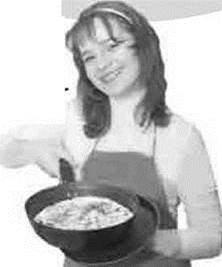
My name’s Lucy. I’m from Kharkiv, Ukraine. I usually cook at home once or twice a week. Cooking’s my hobby.
I cook for my family of four people. I always prepare a lot. They all like my food! Especially pizza, spaghetti, and other Italian food. I spend about an hour on each meal. My mother doesn’t help me! She’s very busy.
Today I can share the recipe for an omelette.
1 Lucy usually cooks … a week.
a three times
b once or twice
c once
2 She spends … on each meal.
a an hour
b half an hour
c an hour and a half
3 Her mother … helps her.
a usually
b always
c never
4 Lucy shares the recipé for …
a Italian spaghetti
b a pizza
c an omelette
OMELETTE FROM LUCY
✵ Take some eggs and break them into a bowl.
✵ Mix the eggs with a fork.
✵ Put some oil into the frying pan. Then put the eggs into it and cook the omelette.
✵ Put some mushroom and onion into the frying pan.
✵ Chop some tomatoes and put them into the frying pan, too. Add some salt.
✵ Put the omelette onto a plate. Your omelette is a wonderful dish for lunch…
b) Speak on your cooking experience. Work in a group.

4. Read the recipe from the cookery book. Then speak in pairs.
A BULGARIAN SALAD
Ingredients:
Sweet pepper — 10 gr Onion — 100 gr Vegetable oil — 20 gr Cucumbers — 300 gr Fennel 1 — 15 gr Vinegar — 10 gr Tomatoes — 200 gr Parsley 2 — 15gr Sugar — 5 gr Salt

Instructions
Slice all the vegetables and combine them in a bowl. Mix all the ingredients. Then slice the parsley, the fennel and add them to the mixture 3. Add salt, vegetable oil and vinegar. Decorate the salad with cucumbers, tomatoes and green onions.
✵ Does your mother use a cookery book?
✵ Have you ever followed the instructions in a recipe?
✵ Share a recipe of any dish with your classmates.
5. Work in pairs. Role-play the situation.
You are arranging a party.
Pupil A is going to cook some dishes.
He / She asks pupil B to do some shopping.
A asks B for help and tells him / her what A needs. B is ready to help and asks questions for details.
for A |
for B |
I need some … |
Do you need some … |
I am going to cook … |
Do you think it will be enough? |
No, … is enough. |
What about some … ? |
You may buy a … |
Why don’t we buy a .? |
1fennel ['fenl] — фенхель, солодкий кріп
2parsley ['pa:sli] — петрушка
3a mixture ['mıkstʃә] — суміш
6. Work in pairs. Role-play the situation.
You are in a restaurant. One of you doesn’t know what to do with all those knives, spoons and other things that the waiter has put in front of him/her. The other tells him/her what each thing is used for.
WRITING
1. Ask your mum and write a recipe of Ukrainian Borsch to your British friend. Use the phrases below.
UKRAINIAN BORSCH

Ingredients:
Cabbage-200 g
Tomatoes — 150 g
Sour cream - 200 g
Parsley- 5 g
Carrot - 200 g
Butter -5o g
Beetroot — 300 g
Onion - 80 g
Dill 1- 5 g
Vinagar2-10 g
Salt
✵ to chop / cut the vegetables
✵ to boil in the pot
✵ to add to other ingredients
✵ to warm up on the frying pan
✵ to peel some tomatoes
✵ to pour into the pot
✵ to put on a plate
✵ to serve with some sour cream
2. Write a letter to your e-mail friend sharing the recipe for the dish you can cook.
1dill [dil] — кpin
2vinegar [՛vınegә]— оцет
LOOK BACK!
1. Look, read and say as in the example.
Mrs Walker couldn’t do any housework because of her broken leg. She made a list and gave it to all the members of her family at 3 o’clock in the afternoon. It is 4 o’clock now. What have her children done? What did they use to do their work?
Do the cleaning, washing, ironing, cooking, sweeping, shopping, washing up, please.
Example:
Mike / to clean/ a vacuum cleaner
Mike has cleaned with the vacuum cleaner.
1 Kate / to wash / with a washing machine
2 Nelly / to iron / with an iron
3 Granny / to cook / on a cooker
4 Bill / to sweep / with a broom
5 Father / to go shopping / by car
6 Grandpa / to wash up / with a dishwasher machine
2. Work in pairs. Ask and answer as in the example.
What shall I do with these?
Peel them first and then chop them.
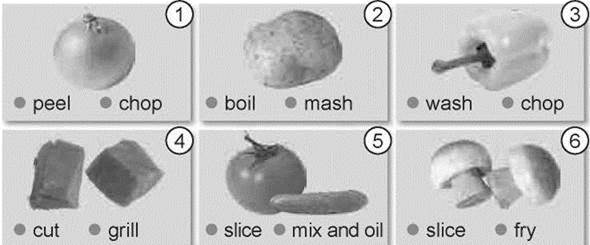
3. Look, choose and read.
MAKE A POTATO SALAD!
1 Peel and (chop / slice) the potatoes and onions.
2 (Bake /boil) the potatoes in a pan.
3 (Add/mix) a little butter with some mayonnaise.
4 (Pour/throw) the mixture onto the potatoes and onions.

4. a) Use ’anything’, ’anybody’, ’anyone’ to rewrite the sentences.
1 There’s nobody at home.
2 There’s no one living in that house.
3 There’s nothing to do this weekend.
4 She said nothing about going to England.
5 I know nobody here.
b) Use ’nothing’, ’nobody’, ’no one’ to rewrite the sentences.
1 I don’t know anybody who can help me.
2 Are you sure she didn’t say anything about it?
3 There isn’t anyone home.
4 I don’t have anything to wear.
5 There isn’t anything good on TV this evening.
5. Use ’few’ or ’little’ to complete the sentences.
1 We have a … sweaters in your size, but not many.
2 Would you like a … sandwiches to take with you?
3 There is a … milk in the refrigerator.
4 We must help. They have … water left and no food.
5 Very … of her poems were published in her lifetime.
6 She has a … close friends.
7 … is known about her life in America.
8 I like these jeans, but they are a … too big.
9 There are very … places where there are no cars.
10 Do you understand? Yes, a … .
6. Read and write down the explanations as in the example.
There are some things which make our everyday home life easier. They are called the electrical household appliances. They are: toaster, microwave oven, cooker, dishwasher, freezer, refrigerator (fridge), food mixer, iron, vacuum cleaner, washing machine, sewing machine and others.
What each of them is for?
Example: A vacuum cleaner is a machine that is used to clean carpets, furniture and floors.
Now go on.
7. a) Read, then listen to Alan, talking about his family and household chores. Find out if the following statements are true or false.

1 They always fight about household chores.
2 They share the chores.
3 Mum and dad don’t like animals.
4 They have a dishwasher.
Household chores? No big deal! In my family we have no problems with household chores. Every Sunday evening we have a little meeting in our kitchen. We discuss all the things that we have to do, and then we make a weekly plan.
Everybody gets some tasks to do. Nobody stays out. Mum puts the list on the fridge door. We check it every night before going to bed. And that's it. The plan works well.
I have to make my bed every day but I tidy up my room once a week. I usually do it on Saturday morning. I also have to lay the table but I don’t have to ctear it. My sister Vicky does it. We all look after our dog. His name is Rex. My sister and I feed the dog but mum and dad have to take it for a walk, twice a day. Mum does the cooking and ironing and dad does thehoovering 1 and takes the garbage out on Tuesdays and Fridays. You know what I really hate?
Washing up. Luckily, everybody has to do it. We take turns.
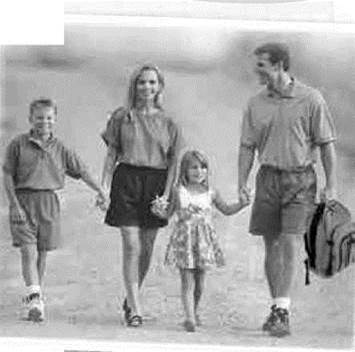
b) Copy the grid. Listen again and tick (
 ) the right box.
Alan |
Vicky |
Mum |
Dad |
|
do the hoovering |
✓ |
|||
make the bed |
||||
walk the dog |
||||
clear the table |
||||
tidy up the room |
||||
do the ironing |
||||
wash up |
||||
do the cooking |
||||
lay the table |
||||
take out the garbage |
||||
feed the dog |
hoovering [՛hʊvәrŋ] — прибирання за допомогою пилососа
8. Give a two-minute talk about yourself.
Use the questions below.
✵ Do you have anything in common 1 with Alan’s family?
✵ Do you share the household chores in your family?
✵ What does everybody do in your family? Use the table on p. 83.
✵ How do you get on with your parents?
9. Listen to the story and write down the recipe of the vegetable soup.
10. You are going to plan and cook a Big Dinner with your friends.
PLANNING YOUR BIG DINNER
1 Work in a small group. Discuss these questions and make some notes.
a) What food can you cook yourselves?
b) What food are you going to cook?
Don’t forget about:
✵ an appetizer,
✵ a soup,
✵ a main course,
✵ a dessert,
✵ a drink.
c) What ingredients will you need?
d) Where will you do the cooking?
e) How long will it take to cook dinner?
2 Make a poster about your meal. Write out the recipes for preparing each course. Don’t forget to note about the time. Design the ’Menu’ for Your Big Dinner and do some drawings.
3 Display your poster and comment on it in class.
FILE FOR PROJECT

1have something in common (with) — мати щось спільне (з)
READING 4 FUN
1. Listen and read.
THE MAN WHO DIDN’T WASH HIS DISHES
(after Phyllis Krasilovsky)
There once was a man who lived alone in a little house in a small town. He always cooked his own dinner, cleaned the house by himself and made his own bed.
One night he came home feeling very hungry, so he made a big dinner. He ate too much and was very tired after finishing. He decided to leave the dishes till the next night.
But the next night he was TWICE 1 as hungry, so he cooked TWICE as big of a dinner, and it took TWICE as long to eat it, and he was TWICE as tired as he had been the day before. As the days passed by, he got hungrier and more tired, and there were so MANY dirty dishes that he started to pile them on the table.
As soon as the table was full he started to put them on his bookshelves. As soon as THEY were full, started piling them on the floor for several days and soon he couldn’t get into his house!
One night he looked in his cupboard and found out 2 that there wasn’t any clean dish there. Soon he used up all his ashtrays 3 and clean flowerpots, and his sweets dishes, and drank water from vases. He used up EVERYTHING, even the pots he cooked his food in, and the frying pan, and the kettle, and he didn’t know what to do! He was SO unhappy. His whole house was full of dirty dishes, and dirty flowerpots, and dirty ashtrays, and dirty sweets dishes, and dirty pots, and a dirty soap dish, and a dirty frying pan, and a dirty kettle. He couldn’t find his books or his clock, or even his BED any more! He couldn’t sit down to think because even his chairs were piled with dishes, and he couldn’t find the sink so he could wash them!
1twice [twaıs] — двічі, 2 рази; тут: вдвічі
2to find out [,faind 'aʊt] — виявляти
3an ashtray ['æʃtreı] — попільничка
But THE RAIN STARTED! And the man got an idea. He drove his big lorry around to the side of his house and piled all the dishes, and all the vases, and all the ashtrays, and pots, and a frying pan, and a kettle on it and drove the truck out into the rain.
The rain fell ON EVERYTHING and soon the dishes were clean again. THE RAIN WASHED THEM! Then the man carried everything back into the house again. He put the dishes into the cupboard, the frying pan and the pots on the pot shelves, the ash trays on the tables, the flowerpots back where he found them, the vases where the vases go, the kettle on the gas cooker, and the soap dish in the bathroom. He was so tired after carrying everything back and putting it away that he decided, «I’d better always wash my dishes just as soon as I have finished my dinner.» The next night when he came home, he cooked his dinner, finished to eat it, washed the dishes and put them right away. He did this every night after that, too. HE IS VERY HAPPY NOW. He can find his chairs, and he can find his clock, and he can find his BED. It is easy for him to get into his house, too, because there are no more dishes piled on the floor or anywhere!

2. Answer the questions.
1 What did a man, who lived alone in the house, always do?
2 How did he feel and what did he do one day?
3 What were the next nights like?
4 Did he wash up the dishes right away after his eating out of them?
5 What did he find out one night?
6 What was his house like soon?
7 What things couldn’t he find? How did he feel?
8 What idea came to his mind?
9 Why was he very tired?
10 What did he decide?
11 Why is he happy at the end of the story?
3. Divide the story into some passages 1 and tell the main idea of each passage.
4. Tell the story as if you were the main character of it.
5. Speak on the following.
✵ What will you decide to do if all the plates are used up?
✵ How long does it take you to wash up the dishes after your dinner?
✵ Do you always start doing washing up right away after your meal?
✵ How do you feel after you have cleaned and put the dishes into their places?
✵ What happens when we don’t put our things in their places and don’t clean them every day? Why?
1a passage ['pæsıdʒ] — уривок
My Learning Diary

The topics of this unit are …
I find this unit very easy /quite easy /quite difficult / very difficult. (Underline what is true for you)
I think that the most important thing I have learnt is …
The most difficult thing for me was …
The things that I enjoyed most in the Unit were …
The things that I didn’t enjoy were …
The ways I used working with the Unit were …
My favourite activities / tasks were
The new grammar I have learnt in the Unit are
The best lesson I had in my English class was
The things that are easy to read are
The things that are easy to listen to …
The things that are easy to talk about …
The things that are easy to write about …
The things that are difficult to read about …
The things that are difficult to listen to …
The things that are difficult to talk about …
The things that are difficult to write about …
Three things I would like to remember from this unit are
… because …
I would like to improve my pronunciation /spelling / vocabulary / grammar/fluency. (Underline what is true for you.)
The things that I would like to learn are …
You have finished the unit. Choose the adjectives that best describe how you feel about it.
happy |
satisfied |
frustrated |
motivated |
good |
relieved |
unhappy |
excited |
sorry |
tired |
After the unit I can:
|
NOW I CAN |
||||
✵ |
name electrical appliances |
|||
✵ |
name kitchen utensils |
|||
describe mum’s work about the house |
||||
✵ |
understand texts about doing chores |
|||
✵ |
ask and answer about my friends’ householding duties |
|||
✵ |
speak on householding duties |
|||
✵ |
express my attitude to householding |
|||
✵ |
use ’something’, ’anybody’, ’nothing’ etc. in speaking and writing |
|||
✵ |
describe my typical day |
|||
✵ |
talk about healthy food |
|||
✵ |
understand texts about cooking methods |
|||
✵ |
give instructions how to cook a dish |
|||
✵ |
read and understand recipes |
|||
✵ |
use ’a lot / lots of’, ’a little’, ’a few’ to express a great amount of smth |
|||
✵ |
talk about cooking meals |
|||
✵ |
share recipes with others |
|||
✵ |
identify place settings when laying the table |
|||
✵ |
speak on table manners |
|||
✵ |
write a recipe of a dish |
|||
✵ |
do a project on planning a dinner for a family |
|||
|
MY WORK |
||||
Перша публікація: 01/01/2015
Останнє оновлення: 31/12/2023
Редакційна та навчальна адаптація: Даний матеріал зведено на основі першоджерела/оригінального тексту. Команда проєкту здійснила редакційне оглядове опрацювання, виправлення технічних неточностей, структурування розділів та адаптацію змісту до навчального формату.
Що було опрацьовано:
- усунення форматних дефектів (OCR-помилки, розриви структури, дефектні символи);
- редакційне упорядкування змісту;
- уніфікація термінів відповідно до академічних джерел;
- перевірка відповідності фактичних тверджень тексту першоджерела.
Усі згадки про автора, рік видання та походження первинного тексту збережено відповідно до джерела.