Підручник Англійська мова 7 клас (7-й рік навчання) - Карпюк О. Д. - Астон 2015 рік
Unit 3 A SOUND MIND IN A SOUND BODY
Lesson 2 DOCTOR! DOCTOR!
VOCABULARY
1. a) Listen and point to the right word.
□ headache
□ toothache
□ stomache
□ earache
□ backache
REMEMBER!
-ache is pronounced [eık]
hurt-hurt-hurt [h3:t]
b) Listen again and repeat.
2. Play ’Health Bingo’
1 Make a Bingo card like the ones on pages 108-109. Write the words from the box below into each square in the order you like.
cold, earache, toothache, broken leg, headache, dentist, doctor, tummy ache, medicine
2 Make up the cards as symbols (pictures) of the words in the box.
3 Take a card and say what it shows. Take turns with a partner.
4 When the word is on your Bingo card, put a symbol on that square.
5 The first person with three symbols in a row wins.
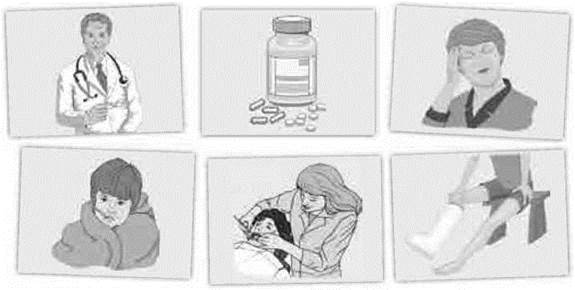

stomach ache |
headache |
dentist |
broken leg |
cold |
toothache |
medicine |
doctor |
earache |
3. Look and say as in the example. Example: John has got a toothache.
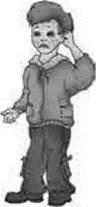
George
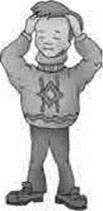
Mark

Alec

Nick
4. Choose the word from the box and complete the answer.
1 Does your head hurt? Yes, I have a …
2 Does your tooth hurt? Yes, I have …
3 Does your ear hurt? Yes, I have …
4 Does your tummy hurt? Yes, I have …
earache, headache, stomach ache, toothache
5. Open the brackets and put the verbs into the correct forms.
Doctor Smile had four patients yesterday. Mr Green … (to feel) dizzy. Mr Smith … (to break) his leg. Mrs Jenkins … (to cut) her finger. Little Bill … (to catch) a cold. The doctor … (to help) every patient. His nurse … (to give) them first aid.
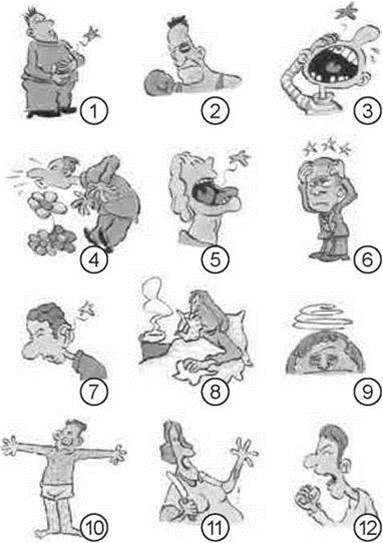
6. Match the sentences to the pictures.
□ He has a rash.
□ He has a toothache.
□ She has a sore throat.
□ He feels dizzy.
□ He has an earache.
□ He has a headache.
□ He has a stomach ache.
□ He has a bruise.
□ She has the flu.
□ She has a cut.
□ He has a cough.
□ He has hay fever.
READING
1. a) Work in pairs. Ask and answer the questions them
1 When does your mother call in a doctor?
2 Why should you take medicine when you are ill?
3 When do people catch the flu?
4 Is your health very good, good or poor?
5 Where do you go when you have a bad tooth?
6 What should you do to keep fit?
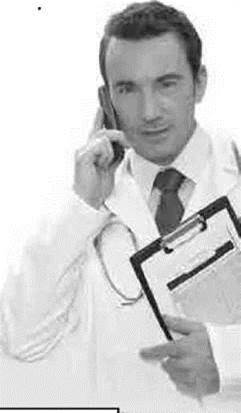
b) Match the texts with the questions above. (There is one extra question).
When you have a bad tooth, you go to the dentist’s office.
When you feel ill, your mother calls in the doctor.
The doctor gives you some medicine. In a short time you’ll get better and be in good health. You’ll be able to go back to school.
Try to keep fit. Then you’ll be in good health. You should do morning exercises. You should play sports and stay outdoors every day. You should eat a lot of fruits and vegetables and other healthy food.

In cold seasons many people catch colds. When you have a cold, you have to drink a lot of hot tea. A bad cold is called a flu. When you have a flu, you can give it to other people around you. So, you must stay at home.
2. Read the article and choose the sentence (A-E) that best fits each gap (1-5).
A Doctors visit their patients at hospitals regularly.
B There are two other useful things for your health: take vitamins regularly and have a complete physical 1 once a year.
C So you have to make an appointment.
D You have to pay there, but it’s usually quick.
E A specialist will examine you and prescribe some treatment, pills, tablets or other medicine, which you can buy at the chemist’s.
HEALTH SERVICE
People need to see doctors if they have a cough, a high temperature or some other symptoms of some diseases. If you are ill you should see your local doctor first. (1) … As disease is usually characterized by a set of specific symptoms and signs, the doctor will ask you to describe the symptoms of your illness. Then he’ll take your pulse, look at your tongue, listen to your heart and lungs and check your temperature. He or she will give you some treatment or send you to see a specialist.
Specialists usually work in medical centres or in hospitals. (2) …
If you feel too ill to go to the doctor’s, you’ll stay in bed and send for a doctor. If you have an accident, you go to the Accident and Emergency department2 of the nearest hospital. Sometimes people need to stay at the hospital for several days or weeks. Surgeons make operations, nurses take care of patients. (3) …
There are many private hospitals today. So you can go to a private doctor or a dentist. (4) … Today many people can get private treatment.

1a complete physical — медичний огляд всіма спеціалістами
2Emergency department [i'm3:gәnsi diıpa:tmәnt] — відділ швидкої допомоги
To be healthy a person needs to live a healthy lifestyle: do regular physical exercises, be outdoors every day, eat only healthy food and get enough sleep. (5) …
3. Say if it is true or false.
1 If you have some symptoms of any disease you should make an appointment with a doctor.
2 If you are ill you should see a surgeon first.
3 Specialists usually work at the dental offices.
4 You should tell the doctor about the symptoms of your disease.
5 You can buy pills, tablets and other medicine at the hospital.
6 When somebody has an accident he goes to a specialist.
7 Surgeons make operations in hospitals.
8 Nurses take care of sick people.
9 You needn’t pay at the private dentist office.
10 A healthy lifestyle helps you keep fit.
11 To have a healthy lifestyle means to take vitamins regularly.
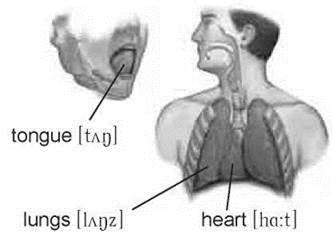
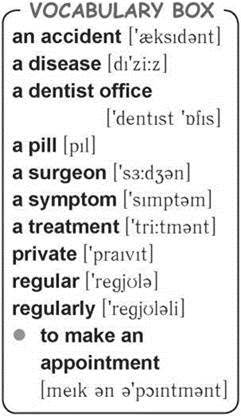
4. a) Get to know some more parts of your body.
b) Play the ’Winner’ game. In a chain name all the parts of the body. The one, who names more is the winner.
5. Complete the sentences.
1 A disease is usually characterized by …
2 The doctor will take your pulse, …
3 Your local doctor can send you to …
4 A specialist will …
5 If you feel too ill to go to a doctor, you’ll …
6 The Accident and Emergency department will help you if you .
7 At hospitals surgeons … ..., nurses .. . and doctors .
8 If you go to a private doctor you have to ..., but it’s …
9 To live a healthy lifestyle means …
10 Taking vitamins and having a complete physical once a year are .
6. Group up the words from the box into 4 columns.
a dentist, to sneeze, a sore throat, a tongue, to cough, lungs, a surgeon, a nurse, a disease, treatment, a heart, to prescribe
symptom |
illness |
part of the body |
health service |
7. Work in pairs. Take turns.
A should say a word on the theme ’Health’.
B should make a sentence with it.
Example:
A: to prescribe
B: A doctor prescribes some medicine you have to take regularly.
8. Say what the doctor usually does when he/she comes to visit your family member. Use the words below.
listens to her heart and lungs, checks her temperature, takes her pulse, tells her take the medicines regularly, tells her how many times a day she should take pills or tablets
GRAMMAR
REMEMBER!
The Past Perfect Tense
I / you / he / we (etc) had done it before she came.
Had I / you / he / we (etc) done it before she came?
Yes, I / you / he / we (etc) had.
No, I / you / he / we (etc) had not.
had not = hadn’t
I / you / he / we (etc) hadn’t done it before she came.

Read § 6, page 205.
1. Work in pairs. Ask and answer the questions.
✵ Had you done your homework before you played with your friends yesterday?
✵ What had you done before mother came?
✵ How much of your test had you done before the lesson was over?
✵ What books had you read before you started reading this one?
1previous ['prі:viәs] — попередній
✵ How many new English words had you learnt before you started this unit?
✵ Had you written your essay by 3 o’clock yesterday?
✵ Had you had your breakfast before you came to school?
✵ Had you come to school before the first lesson started?
Had you done your …?
Yes, I had. / No, I hadn’t.
REMEMBER!
The Past Perfect Tense
(Минулий перфектний час)
Ця часова форма вживається:
✵ для позначення дії, яка трапилась у минулому перед іншою дією минулого часу.
When I got home, Mike wasn’t in. He had gone to the cinema.
I didn’t go to the cinema because I had already seen that film twice.
✵ для позначення дії, яка трапилась перед зазначеним часом у минулому.
Suzan had done all the housework by seven o’clock in the evening.
✵ для позначення дії, яка є причиною наступної дії чи стану у минулому.
Порівняйте ситуації:

Примітка.
З минулим перфектним часом вживаються слова: before, after, already, just, till / until, when, by, by the time, etc.
✵ The Past Perfect Tense утворюється за допомогою дієслова had + 3rd form основного дієслова. had finished had done
She had taken some medicine before she checked the temperature.
2. Read and make up the sentences as in the example.
Max came back home from school and found out that some things had changed.
Example: Ann / clean the flat with the vacuum cleaner
Ann had cleaned the flat with the vacuum cleaner before Max came back home from school.
1 Little Fred / break his leg
2 Father / call in the doctor
3 Mother / give Fred some medicine
4 Granny / cook dinner
5 Nobody / read Fred a fairy tale
3. Match the column A with the column B to make correct sentences.

4. Join the sentences using the words in brackets.
Example: The doctor took Bill’s pulse.
Then she listened to his breathing. (after)
After the doctor had taken Bill’s pulse, she listened to his breath.
1 Kate had her lunch. Then she took some medicine. (after)
2 Jim ate some ice-cream. Then he had a bad toothache. (when)
3 Sally drank a glass of warm milk. Then she felt better. (after)
4 Mother went to the chemist’s. Then father arrived. (before)
5 Sam recovered from his illness. Then the day of his birthday came. (by the time)
5. Read, then work in pairs. Ask and answer. Use the clues below as in the example.
Jane fell ill and her mother called a doctor.
What had mother done before the doctor came?
Example: lay Jane / bed
A: What had mother done before the doctor came?
B: She had laid Jane into bed.
1 put on / warm blanket
2 give / a glass of warm milk
3 check/temperature
4 clean / carpet
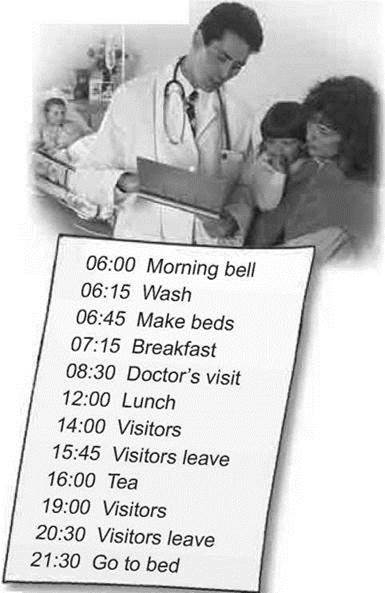
6. Work in pairs. Look at the hospital timetable. Ask and answer as in the example:
A: Had they washed themselves before they made beds?
B: Yes, they had.
7. Put the verbs in brackets into the Past Perfect Tense.
1 It was a feeling he (never; to feel) … before.
2 The woman, who (to be) … on a diet for a year looked younger than her age.
3 After he (to cut) … his finger, he washed it and put on a plaster.
4 I felt better after I (to take) … a tablet of aspirin.
5 We were pleased to see Alex again. We (not; to see) … him for a month.
6 Rose felt very tired after she (to work) … in the garden.
LISTENING
1. a) Listen to Dialogue 1. What’s the problem? Put the questions in the order they come up.
□ What’s wrong?
□ Why don’t you go and see the doctor?
□ Are you feeling OK?
Now, answer the questions.
b) Listen again. What does Fiona tell Barry to do?
2. Listen to Dialogue 2. Fill in the grid.
Name |
|
Problem |
|
How long? |
|
Medicine |
|
Next visit |
3. Listen again. Answer the questions.
1 How did Danny hurt his shoulder?
2 Whose fault was it?
3 Do you like Dr Grey? Why?
4. Work in pairs. Listen and act out the dialogues.
1 |
2 |
A: What’s the matter? |
A: Could l see a doctor, please? |
B: I have a terrible cough. |
B: Who is your doctor? |
A: Take this medicine |
A: Dr Russel. Is he here this |
three times a day. |
morning? |
B: For how long? |
B: I’m afraid he isn’t. You will have |
A: For five days. |
to come in the afternoon. |
5. a) Listen and learn the rhyme.
YOUR COLD IS GETTING WORSE
— Your cold is getting worse You should see the nurse
— Oh, no, I’m fine.
My cold is much better.
— Your cough is getting worse You should see the nurse
— Oh, no, I am fine.
My cough is much better.
— Your cough sounds bad.
It doesn’t sound good.
You should see the nurse You really should.


b) Say the rhyme in pairs.
SPEAKING
1. Work in pairs. Ask about the patients and answer as in the example.
Example:
Anna / a sore throat / for a week
A: What happened to Anna?
B: She had a sore throat.
A: How long had she had it?
B: She had had it for a week.
1 Tim / a headache / for three days
2 Jane / a cough / for two weeks
3 Adam / a cold / for a week
4 Mick / flu / for ten days
5 Rosie / earache / for a weekend

2. Disagree as in the example.
Example:
— You have a sore throat when you keep to a diet of fruit.
— I’m afraid you are not right. You don’t have a sore throat when you keep to a diet of fruit.
1 When you suffer from a headache you have a pain in the stomach.
2 When you suffer from an earache you have a pain in your leg.
3 If you are on a diet you usually eat a lot of fried meat.
4 Your mother lets you eat ice cream when you have a sore throat.
5 You never stay in bed, when you are seriously ill.

3. Use the columns to make sentences as in the example. Example: Jim / check / his temperature ______✵ go to bed a After Jim had checked his temperature, he went to bed. b Jim had checked his temperature before he went to bed.

4. Work in pairs. Complete the dialogue, then role-play it.
Take turns.
Patient: Oh, Doctor…
Doctor: I see. Take off your blouse. I would like to listen to you heart and lungs.
Patient: Yes, Doctor. And.
Doctor: Have you taken your temperature?
Patient: … .
Doctor: Don’t worry. …
Patient: What shall I take for my cold?
Doctor: … .
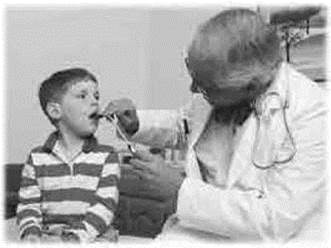
5. Work in pairs. Ask the question and act out an answer.
A: What’s the matter?
B: I’ve got a …
A: I think you should …
For A |
For B |
drink some water |
a headache |
rest |
a backache |
take some medicine |
a sore throat |
see a doctor |
a temperature |
lie down |
L a cold |
REMEMBER!
Offering Help
Would you like a glass of water / an aspirin / some cough medicine? Would you like:
✵ to sit / lie down?
✵ to go home / go to bed?
✵ to take an aspirin?
✵ to see a doctor?
6. Work in pairs.
A says he/she feels like he/she has got something wrong with him/her.
B offers his/her help and gives advice.
Use phrases from tasks 4 and 5.
7. Work in groups. Pretend you are a doctor.
Ask your classmates questions about their health.
8. Speak on the following.
1 Do you often catch cold?
2 Where do you go to get a treatment?
3 What does a doctor usually do to prescribe some medicines you need?
4 Where do you go to get your medicine?

5 Do you enjoy good health? What should you do to keep on being healthy?
6 What do you do if you have a toothache?
7 Have you ever had an operation? If yes, tell about the medical service at the hospital you have been taken to.
DO YOU KNOW?
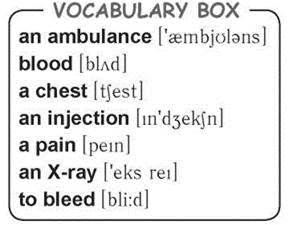
First aid means help.
If 1 you cut your finger, wash it and put a plaster 2 on it. Every night take the plaster off. Put a new plaster on in the morning. You should keep your cut clean. If the cut is serious, go to see a doctor.
Sometimes people feel dizzy. It is often because of bad weather or bad food. If you feel dizzy, bend forward and put your head close to your legs. The blood 3 will go to your head. You’ll feel better.
WRITING
1. Choose the word from the box and complete the story.
cold, headache, fit, doctor, healthy, flu, felt, care, medicine
Once my friend … ill. He was hot and had a … . We called in a … . My friend was lucky — it wasn’t … . He caught a … .
The doctor gave some … and said my friend should stay in bed. Then the doctor told that we should take a special … of our health when it is winter. We should keep …: do morning exercises and eat … food.
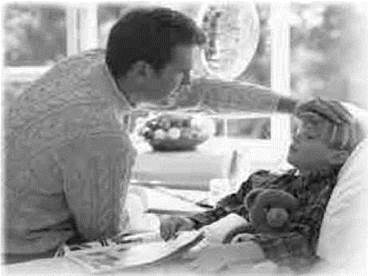
2. Write about the time you got sick or hurt.
✵ How did you feel?
✵ What did you do?
✵ What treatment did you get?
1if — якщо
2a plaster ['pla:stә] — лейкопластир
3blood [blᴧd] — кров
LOOK BACK!
1. Match and say.

2. Fill in the gaps with the words from the box.
checked, temperature, prescribed, throat, sneezing, stay in bed, recover, flu, sore throat, took a pulse

The doctor was a nice woman. She visited John at his home.
She … and listened to his breathing. Then she examined the boy’s … . It was bright red.
Doctor … John’s … . It was rather high. She said it wasn’t … but just a bad cold.
John was … and coughing all the time. But the doctor promised that he would be better in several days. She … some medicine for his headache and his … She asked mother to buy the medicine and John to … for 3 days. She told John he had to drink warm milk with butter, honey and mineral water. Then he would … soon.
With these words the doctor left the room.
3. What people do if:
✵ they have a headache
✵ they can’t sleep
✵ they have a toothache
✵ they have a pain in the heart
✵ they have a cold
✵ they have a stomachache
to go to the dentist,
to call a doctor, to go to bed,
to take some medicine,
to have a walk outdoors,
to drink warm milk,
to drink warm milk with honey or butter
4. a) Read the letter and say what once happened to Michael.

b) Answer the questions.
1 How long has Michael been off school?
2 How did he break his leg?
3 How long did he stay at the hospital?
4 Who brought him home?
5 How did he feel being at home?
6 How many word puzzles had he done?
7 What advice does Michael give us in his letter?
5. a) Read another letter and say what was the most difficult thing for Kate in her situation.
Dear Ann,
I’d like to tell you about the time when Mum and Dad went away on their business and left me and my sister for 3 days.
Sally Was five at that time. She started to feel ill on Monday evening. She had a temperature, a headache and a sore throat. She wanted to watch cartoons on TV, but she couldn't and went to bed early. She stayed in bed on Tuesday morning and l had to phone the doctor. The doctor arrived at 11:30. He looked at Sally’s throat and checked her temperature.
Sally needed some medicine. The doctor wrote a prescription and gave it to me. I bought the medicine at the chemist’s paying with the money Mum had left for us. It was really difficult to make Sally take the medicine. I had to do different tricks and tell lots of fairy tales to Sally to make her get the treatment the doctor had prescribed.
That’s why I was the happiest person on Thursday morning when mother came back home. She said I had a useful experience. It’s true, but in my opinion, I was too young to be a nurse for my sister.
Kate
b) Work in pairs. Make up your questions to interview Kate.
A is Kate.
B is an interviewer.
Tell me about…
What about…?
What kind of problems did you have?
What happened after…?
What had you done before…?
6. Work in pairs. Choose a partner and ask him questions about:
— his health;
— his last illness;
— his last visit to the doctor.
Take turns.
7. Work in a group of three. Role-play the talk between the doctor, John and his mother.
A, you are John. You feel sick and dizzy. Answer the doctor’s questions.
B, you are John’s mother. You can ask some questions, as well as say the words that you understand the doctor and you are ready to follow the instructions.
C, you are the doctor. Ask John questions, answer his mother’s questions. Give instructions.
8. a) Do the questionnaire. Choose your answers.

1 HAVE YOU GOT ANY OF SPORT THINGS AT HOME?
□ a) not any
□ b) some of sport posters and books
□ c) some of sport equipment
2. HAVE YOU EVER ATTENDED ANY SPORT CLUB?
□ a) Yes, I have. But I don’t attend this year.
□ b) No, I haven’t.
□ c) Yes, I have. I attend a sport club twice a week.

3. ARE YOU GOING TO TAKE PART IN INTERSCHOOL COMPETITION?
□ a) yes
□ b) no
□ c) possibly
4. WHAT ARE YOU GOING TO DO THIS WEEKEND?
□ a) play some new computer games
□ b) watch football on TV
□ c) go out and play sport games
5. HOW MANY TIMES A WEEK DO YOU DO SPORT?
□ a) every day
□ b) twice a week
□ c) never


6. WHAT DO YOU KNOW ABOUT OLYMPIC GAMES?
□ a) nothing at all
□ b) the names of gold medal winners in six or more kinds of sport
□ c) the history of Olympics
7. DO YOU ENJOY YOUR PE LESSONS AT SCHOOL?
□ a) not very much
□ b) Yes, I do. PE is my favourite subject.
□ c) I hate PE

8. HAVE YOU EVER DREAMED OF BECOMING A SPORTS STAR?
□ a) sometimes
□ b) never
□ c) very often

RESULTS:
More than 10 points:
Congratulations! Go on and you’ll be in your best sporty shape.
5-10 points:
You are a sports fan.
It’s not so bad.
Less than 5 points: You and a sporty person are quite different things.
b) Find out your score.
c) Listen to Sheila and Alan. Write down their answers to the questionnaire and calculate their points 1.
9. Join the sentences using the words in brackets.
Example: I had a pill. Then I stopped coughing. (After)
After I had a pill I stopped coughing.
1 I washed my hands. Then I had my lunch. (Before)
2 Steve learnt to control his bike.
Then he started practicing tricks. (After)
3 The doctor examined his patient.
Then he gave him an injection. (Before)
4 Children did their homework. Then their mother came. (Before)
5 The doctor gave me a treatment.
Then I went to the chemist’s. (After)
6 We came back from the Sport Show.
Then we had a big dinner at Granny’s. (After)
7 Fiona was a member of the climbing club.
Then she started swimming. (After)
8 Nick was a member of our school volleyball team.
Then he joined tennis club. (Before)
10. Work in groups of six. Play ’Tag-Question Game’.
Two pairs play and one pair acts as a referee.
pair A: We’re playing tennis tomorrow.
pair B: … aren’t we?
pair B: I’ve never played basketball..
pair A: … have I?
For every correct tag question you get two points. If you answer incorrectly or take more than ten seconds to think, the other team gets two points. After five minutes stop the game and see who the winners are.
1to calculate ['kælkjuleıt] smb’s points — підрахувати чиїсь бали
11. Have you (your friend) ever taken part in any sporting event? Describe your (your friend’s) actions and feelings during it.
12. Work in groups of four-five and follow the steps.
FILE FOR PROJECT
OLYMPIC GAMES IN FUTURE
Step 1. Discuss the following:
Will the Olympic Games exist in 2092?
What country will host the Olympic Games? Why?
Will the Olympic traditions change? What would you like to change: the flag, the flame or the motto?
Step 2. Design your own emblem.
Step 3. Introduce your own new sport into the Olympic programme.
✵ Invent your new sport.
✵ Describe the basic rules.
✵ List the equipment or special clothes needed.
Step 4. Design sports clothes for the Ukrainian team.
Step 5. Write a short script which describes the opening ceremony.
✵ How many countries will take part in the Olympic Games?
✵ How many competitors will be there?
✵ What will happen there?
Step 6. Imagine you are a journalist who visited these Olympic Games. Describe the Olympics — 2092, how long they took and what the weather was like, what sport competitions you visited, who won or lost and which the most exciting events were.

READING 4 FUN
1 Listen and read.
HE WAS ONLY WRONG BY TWO!
John was a football coach at a British University. He always tried to find good football players for his team. John trained his players very well.
They were good at running, jumping, swimming, rowing and playing different games. They often took part in races and practically always won. All John’s players were tall strong men, excellent sportsmen and just nice people. They hardly ever gave him trouble and the University team was the best in the South of England. Regular training, keeping to a diet and a lot of exercises were very important for the sportsmen. They always followed the coach’s advice and received good and excellent results in all home and international competitions and matches. They rarely lost a game or hardly ever ended matches in a draw. In fact, they practically always won.
The only trouble with some of his football players was their poor knowledge of many school subjects because the sportsmen were often not good at Maths, English, etc. and it was not always easy for them to be good University students.
One day the coach brought an excellent young football player to the Professor of the University. The Professor had to ask the young player some questions. The Professor chose very easy questions, but the boy couldn’t answer them. At last the Professor asked, «Well, what’s five times seven?» The student thought for a long time and then answered, «Thirty-six.»
The Professor shook his head and looked at the coach. «It’s impossible!» he said.
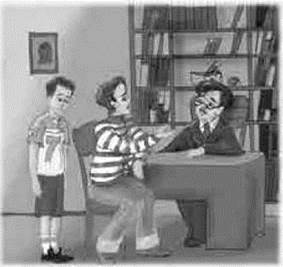
«I don’t want to punish your team. I understand he can throw a ball very well, but he doesn’t know mathematics at all. He can’t be a student.»
But the coach seriously asked, «Oh, please, sir! Let him become a student.
He was only wrong by two.»
2. Complete the sentences according to the text.
1 John tried to find …
2 John’s football players were good at …
3 The players were …
4 The University team was………..
5 The important things for the sportsmen were …
6 The footballers rarely …
7 The only trouble with some footballers was …
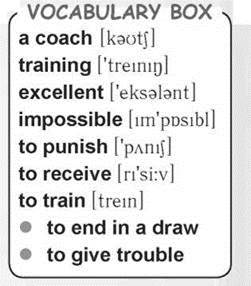
3. Answer the questions using the words and phrases from the ’New Vocabulary’.
1 Who trains sportsmen for international competitions?
2 What do we call members of a football team?
3 What do sportsmen do to keep fit and be in an excellent form?
4 How does the game end if the result is 0:0?
5 What can a coach say to his sportsman who hasn’t trained for a long time?
6 What kind of student is a boy or a girl if he/she gets very good marks?
7 If you were a teacher, would you use any punishment?
4. Retell the story as if you were:
a the coach;
b the Professor;
c a new football player
My Learning Diary
The topics of this unit are …
I find this unit very easy /quite easy /quite difficult / very difficult. (Underline what is true for you)
I think that the most important thing I have learnt is …
The most difficult thing for me was …
The things that I enjoyed most in the Unit were …
The things that I didn’t enjoy were …
The ways I used working with the Unit were …
My favourite activities / tasks were …
The new grammar I have learnt in the Unit are …
The best lesson I had in my English class was …
The things that are easy to read are …
The things that are easy to listen to …
The things that are easy to talk about …
The things that are easy to write about …
The things that are difficult to read about …
The things that are difficult to listen to …
The things that are difficult to talk about …
The things that are difficult to write about …
Three things I would like to remember from this unit are …
… because …
I would like to improve my pronunciation /spelling / vocabulary / grammar/fluency. (Underline what is true for you.)
The things that I would like to learn are …
You have finished the unit. Choose the adjectives that best describe how you feel about it.
happy |
satisfied |
frustrated |
motivated |
good |
relieved |
unhappy |
excited |
sorry |
tired |
After the unit I can:
|
NOW I CAN |
||||
✵ |
understand texts about the Olympic Games |
|||
✵ |
fill in the application form with my personal information |
|||
✵ |
understand and use question tags in the interview |
|||
✵ |
ask and answer about the rules of a sport or a game |
|||
✵ |
listen and understand sport commentaries |
|||
✵ |
express an opinion about a sport event |
|||
✵ |
do a questionnaire about being sporty |
|||
✵ |
make a factfile about a sportsman |
|||
✵ |
tell about my favourite sportsman |
|||
✵ |
name the symptoms of a disease |
|||
✵ |
ask and answer about feelings |
|||
✵ |
offer help and give advice to someone who doesn’t feel well |
|||
✵ |
understand and use the Past Perfect Tense |
|||
✵ |
understand texts about health service |
|||
✵ |
speak on a treatment |
|||
✵ |
talk with a doctor |
|||
✵ |
interview about smb’s visit to a doctor |
|||
✵ |
describe an experience of being ill |
|||
✵ |
write about a sport event |
|||
✵ |
write about a sportsman |
|||
✵ |
do a project about the Olympics in future |
|||
|
MY WORK |
||||
Перша публікація: 01/01/2015
Останнє оновлення: 31/12/2023
Редакційна та навчальна адаптація: Даний матеріал зведено на основі першоджерела/оригінального тексту. Команда проєкту здійснила редакційне оглядове опрацювання, виправлення технічних неточностей, структурування розділів та адаптацію змісту до навчального формату.
Що було опрацьовано:
- усунення форматних дефектів (OCR-помилки, розриви структури, дефектні символи);
- редакційне упорядкування змісту;
- уніфікація термінів відповідно до академічних джерел;
- перевірка відповідності фактичних тверджень тексту першоджерела.
Усі згадки про автора, рік видання та походження первинного тексту збережено відповідно до джерела.