Підручник Англійська мова 9 клас (9-й рік навчання) - О. C. Любченко - Основа 2017 рік
UNIT 1 Mamma, it was summer!

Lesson 1 YOUTH MUST BE SERVED
1. Do you know what a «cinquain» is? It is a short five-line (from the French «cinq» — «five») poem with no rhyme. Look at the example: Computer Cold, silent Thinking, Producing, Calculating Smarter than me, maybe? Machine

Line 1 - One word, also the title
Line 2 - Two adjectives that describe the word in line one
Line 3 - Three words with more information about the subject.
Line 4 - Four words that show emotion about the subject - either individual words or a phrase/sentence
Line 5 - Synonym of the title or a word very similar to it.
In pairs, make a cinquain about youth on an A4 piece of paper. Each pair posts their poem on the board, and the class votes for the best cinquain.
2. a) Look at the pictures of representatives of some popular youth subcultures on p. 11. What do they look like? What do you feel when looking at them? You may use the following words: aggressive, attractive, arrogant, cheeky, glamorous, picturesque, strange, weird, freak, funny, dangerous, etc.
b) Choose one picture and describe it. Tell about:
✵ people’s appearances
✵ people’s clothes
✵ people’s possible behaviour Use the words above or add words of your own.
3. Read an extract from the article on youth subcultures and find the representatives of those among the pictures above. Explain your choice.
Did you know?
12% of the population in England and Wales were aged 16-24 in 2011, down from 16% in 1911.
Young people have always tried to find out where and what they are in this world by trying to stand out of the crowd. It may most easily be done by protesting against the adult society, its rules and values. That is why a lot of youth subcultures appeared in the late 20 th century. They were mainly based on different music styles and teenagers tried to copy their idols in everything - appearances, fashion, preferences and lifestyles. Of course, they differed greatly - from peaceful hippies to aggressive skinheads.


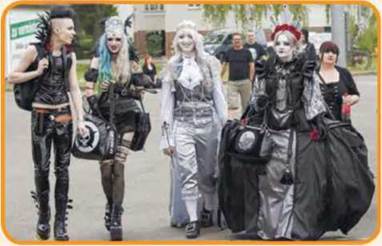

Then came rockers and later metallers with their black leather jackets and Harley Davidsons, but… it all was gone in a short while. With time, the idea of seeing the future as dark and hopeless dominated the minds, and youth groups turned from rebellious to negatively apathetic. The appearances turned into a mixture of aggression and absurdity (punks) or into a contrast between black clothes and whitened skin (Goths), or brought up unnatural hair colours - mainly pink (Emos). But with the development of the Internet everything has gone a different way…

4. In pairs, find the ways to replace the words and phrases in bold in the article with their synonyms. Then, close your books and try to use these words and phrases to reconstruct the article to the class. In class, decide, which of the reconstructions was closest to the article.
5. In groups, discuss the order, in which the youth subcultures mentioned in the article appeared. Use your personal knowledge and experience. Discuss the results in class.
6. Speaking. Which of the subcultures have you personally known? Where and how did it happen? What were your impressions? Share your experiences with the class.
7. The key idea of any youth subculture is some kind of protest against society. Imagine you want to create a subculture of your own. What will it be like? Will it be more peaceful and quiet or more cheeky and aggressive? Will there be any special clothes? Makeup? Artifacts? Write a short passage of about 70—80 words.
Перша публікація: 01/01/2017
Останнє оновлення: 31/12/2023
Редакційна та навчальна адаптація: Даний матеріал зведено на основі першоджерела/оригінального тексту. Команда проєкту здійснила редакційне оглядове опрацювання, виправлення технічних неточностей, структурування розділів та адаптацію змісту до навчального формату.
Що було опрацьовано:
- усунення форматних дефектів (OCR-помилки, розриви структури, дефектні символи);
- редакційне упорядкування змісту;
- уніфікація термінів відповідно до академічних джерел;
- перевірка відповідності фактичних тверджень тексту першоджерела.
Усі згадки про автора, рік видання та походження первинного тексту збережено відповідно до джерела.